
A Pathway to Wisdom in the Business World

Businesswoman in office drinking coffee and looking at computer

Depositphotos_73412631_s-2015

Wisdom equals knowledge plus courage. You have to not only know what to do and when to do it, but you have to also be brave enough to follow through.Jarod Kintz

Perhaps we think of the workplace as being too busy to spend time learning. But if we are wise, we will use every opportunity to gain knowledge. Here are some tips on how to gain wisdom during the time we spend at work:

  • Never stop learning / learn from diverse sources

Be open to learning in non-traditional ways. New information can come from sources other than books or training seminars. Being open minded and steadfastly curious will create a pathway to continuous learning. For more on this, check out my post Work and Jazz on how guitar lessons helped me understand my learning style and how to get outside of my comfort zone:

  • Find ways to apply your knowledge

Driving change and improving systems and processes is an important role for each member of a business team. Knowing that status quo is an undesirable state helps to create an environment for continuous improvement. Finding ways to drive tangible, positive change with newly found knowledge should be in the business DNA of each employee and influence his or her ways of working. Always be looking for ways to apply your learning.

  • Use new and emerging technologies to enhance your knowledge

Having an open mind about continuous learning includes embracing technology and being open to using new tools to gain knowledge. The features of today’s hand-held devices, such as smartphones and tablets, are amazing. Wifi and streaming video services have made learning much more accessible because it can take place on our individual schedules. The variety of ‘platforms’ available for learning seems limitless and will continue to grow. If trying new technology is difficult for you, find ways to understand it and become more comfortable. Being on the cutting edge can be very exciting.

  • Gather support along the way and take risks

In the business world, risk-taking is viewed differently in every organization and even varies within organizations from department to department. As we learn more and consider the use of new tools to improve systems and processes, it often takes a mentor or sponsor to gain support for improvement projects or process enhancements. Depending on the perceived risk level, getting the boss to ‘try’ something new can be very challenging. However, developing the supporting justification for a change and finding the courage to ask for support will show dedication and initiative.

  • Follow through on plans and actions

Ideas and plans are nice to have, however putting them into action will take considerable effort and courage. The people in the organization who develop the vision, generate an action plan, gather support, and then execute these plans effectively will be extremely valuable.

In the workplace, wisdom is gained by those who remain curious, stay open to new ideas, find support, and successfully execute their plans. In the business world, as in the world outside of work, the pathway to wisdom is a journey we can choose. May you find your own path to wisdom.


Photo credit: Depositphotos.com #73412631 gustavofrazao

Who Drives Vision to Reality?

Hand holding classic Edison light bulb

Thomas Edison was a visionary, and one of the most influential people in modern human history because he understood the effort it took to successfully execute a vision.

Vision without execution is delusion. Thomas Edison

During my 30 plus years in a large corporation, I worked with many people who had vision but not everyone was able to turn their vision into reality. Although it is true that in many organizations Leadership is responsible for developing the vision, implementing their plans was usually left to others in the organization. Unfortunately, if a solid connection was not made between Leadership’s vision and the plan for execution, the project wouldn’t succeed.

 I’ve had the good fortune to work on several successful teams and it became clear to me that the success of a project was usually a function of Who was on the team. I noticed the successful team members consistently took the following action steps:

  • Connected the vision to the work. The team members who were successful at execution were able to connect the project’s goal (vision) to their current work and the overall success of the organization. The path was clear to them on how the vision could be achieved and how it would positively impact their jobs and the success of the company.
  • Developed an effective plan. Successful members were well organized and able to develop an effective plan for themselves and enlist their teammates in the effort. Their plans for success were well documented and communicated to the team. This communication fostered a sense of ownership and a feeling of transparency that was inherently healthy.
  • Obtained access to accurate and timely data. Success was possible when accurate information and data were readily available. The successful team member knew how to obtain and use the information effectively to drive the project. Those who were able to execute the plans were well versed in using the data management tools available to them. If the tools weren’t available, they would develop their own set of tools that made gathering data and reporting very efficient.
  • Provided clear and concise communication with all stakeholders. This means they developed and published the progress of the project to all interested parties. Communicating pertinent information on a timely basis allowed for discussion of the results and insights. If the information was clear, complete, and concise, it provided guidance to Leadership and facilitated an honest discussion of the project’s progress. In this environment, the project had a greater chance of success.

A team member who understood the planning and hard work it took to achieve the vision got noticed and was always given more opportunities to be successful.

Thomas Edison had many quotes, but this one pulls it all together: Opportunity is missed by most people because it is dressed in overalls and looks like work.


Photo credit: Depositphotos.com 85115774 4masik

What is in Season?

IMG_1708

In 1965, a folk-rock band, ‘The Byrds’, recorded their version of Pete Seeger’s song, ‘Turn, Turn, Turn’. The lyrics refer to there being a time for many activities and events, including a time to plant and a time to harvest. Although I’ve heard the song hundreds of times over the years, it had a new meaning for me when I became a supply chain manager.

Consumers want the freshest food possible, necessitating that manufacturers maintain the freshest inventory possible. This is especially true for fruits and vegetables used in processed or semi-processed foods. If these fruits and vegetables are grown in specific geographies, it can be very difficult to maintain a fresh inventory year round. Under these circumstances, purchasing the correct amount of these items is a challenge, and not having enough material to cover the requirements before the next harvest is an obvious problem. Conversely, purchasing too much material can be a problem if the shelf-life of perishable items expires before they can be utilized.

One of the biggest challenges of my career was managing the inventory of perishable materials. My colleagues and I developed a system for calculating the quantity of material to be purchased based on when new material needed to be contracted/purchased and the forecasted rate of the material’s consumption in the production of finished goods.

We determined that it worked best for the people in charge of procurement to frequently talk directly with operations people who have knowledge of the business and production planning. This not only guaranteed the freshest possible product for our customers, it reduced financial losses due to expired materials. It also minimized the need to make emergency purchases at a higher cost on the spot market to make up for shortfalls in the inventory. To facilitate these discussions, we developed a sophisticated spreadsheet tool to capture pertinent information.

Based on our experience, here are the recommended steps for developing an inventory management tool and using it to plan the best purchasing strategy for your business.

  1. Establish the parameters for product availability

List all of the items to be purchased and then answer a few simple questions about everything on the list: What is the shelf life of the material? Where is the item grown? Is it available from sources outside of your country? Is it available in the opposite hemisphere, i.e., if you are located in the northern hemisphere, can the item be grown in the southern hemisphere and shipped economically to your location? Once this information is developed, the purchasing plan can be established.

  1. Develop a consumption model

To predict the consumption of the material, a model will be required to show the projected inventory level of each item. This will require the production forecast by month, and the amount of material used in each finished good item to calculate the usage. Monthly consumption is the most convenient way to view the information. When developing the model, a ‘loss factor’ should be added to the formula to account for material wasted or damaged during storage and/or manufacturing. If the material is used in multiple finished good items, cumulative usage should be tracked and reported as a single number.

  1. Develop the inventory model

 Utilize the product availability parameters (step 1) and consumption model (step 2) to set up a tool that will show the inventory levels at the beginning or end of each month. The third variable in the inventory model should show the contracted quantities and when the material is available for usage.

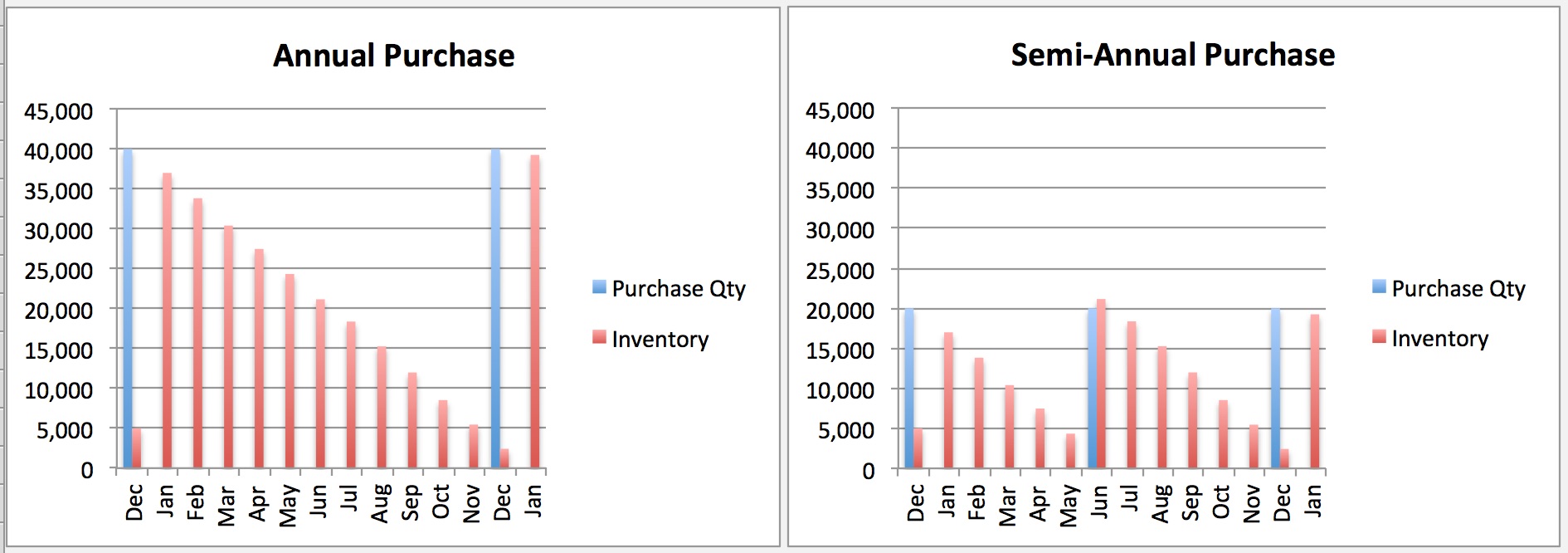
Combining the inventory, consumption, and purchase quantity will generate a ‘strategic’ view of the available inventory over time. Understanding the strategic view of the inventory will indicate when to purchase the material again in the future.

Once the inventory model is working and actual inventories are updated each month, the inventory levels can be predicted for each time period. Management can then determine if there is a risk of running out of materials or conversely, predict if there will be excess material left over that will expire before it can be used. Examples of an annual purchase and semi-annual purchase inventory model are shown below:
Final Screen Shot 2015-11-30 at 2.05.09 PM

  1. Review Inventory and Adjust Purchasing Strategy

The most important step of this process is for the appropriate parties to review the inventory positions on a monthly basis, even if the purchase date is several months away. For example, if sales are not going as planned, then a strategy can be developed to manage the potential issues of running out of material prematurely or having excess material that will expire and cannot be used. Ideally the Operations group will know how sales are trending and this intelligence can be brought to the attention of the Procurement group.

  1. Establish Timetables for Making a Purchase Decision

The process works well when a timetable is developed for each item. In general, the process is to jointly review the inventory plan and forecast 3 months prior to when the material is available for purchase. The forecast should be verified with the Production Planning/Scheduling department two months prior to contracting the item. This gives Procurement enough time to develop the quantity requirements and negotiation strategy to be executed in the month prior to the delivery on the contract.

Some companies may have ERP/MRP systems that will generate similar information for a material, however, it is important to have a tool to facilitate the discussions between Procurement and Operations. These discussions need to take place with some frequency to ensure necessary adaptations to business plans.

It may take a few months to develop and launch this entire process, but once it is running and the monthly review of inventory is taking place between Procurement and Operations, the benefits are substantial. Having a sensitive and efficient process for updating the consumption model and the inventory model is key to success. Accurate and timely information will lead to better decisions and improved business results.

It is safe to say that the Byrds were not thinking about inventory position and consumption models when they recorded one of their most famous songs, but it’s easy to hear the wisdom in their chorus:

‘There is a season – turn, turn, turn

And a time to every purpose under heaven’



Build Bridges of Understanding – Part 2

Find the Answer - Magnifying Glass


Building Bridges Part 1 addressed how to gather useful information by having honest conversations with the people involved in the issue. Gathering as much information as possible was the key to determining exactly what happened. However, fact gathering is only a part of the process; it is equally important to implement improvements based on the information.

The highest levels of performance come to people who are centered, intuitive, creative, and reflective – people who know to see a problem as an opportunity. – Deepak Chopra

Here was the journey we took to solve the problem described in Part 1.

Once we gathered the preliminary information, we decided that the issue was most likely related to the raw material handling process. As we dug into the details of how the raw materials were handled we started asking questions such as, “how could one raw material be introduced into another raw material?”

We then discussed scenarios in which the offending material might have been introduced into a ‘common’ raw material, and developed one such scenario:

Contamination may occur when an offending allergen (seafood) attached itself to a common ingredient (pasta) because it was unsuccessfully separated out during the ‘re-work’ process (used to reclaim raw materials from damaged packages). When the ‘contaminated’ pasta was used again, it was used as raw material for a product that didn’t contain seafood. Thus, the process for re-using raw materials from damaged packages would have created the situation where unwanted ingredients were inadvertently mixed into the raw material.

As we talked through this scenario, we realized that a process intended to avoid wasting materials, actually put the product at risk. Armed with this information, we were able to determine the most likely root cause for the issue.

We were now presented with the ‘opportunity’ to eliminate the potential for contamination. This would involve changes in the material handling procedures and a commitment to a training program for the workers who manage the tracking paperwork. The owner of the business was amenable to the changes; peace of mind about the safety of his products was well worth any additional expense. The changes were effective. Millions of packages were consumed over the next 15 years without incident.

To summarize, here’s the entire process:

  1. Open up an honest and in-depth discussion about the situation and ensure everyone involved is on the same page. Establish the goal of the discussion and keep it in mind the entire time.
  2. As the discussion leads to various possible scenarios that could explain what occurred, critically and thoroughly review the scenarios – the smallest detail can lead to the smoking gun.
  3. Once the root cause is determined and verified, develop ‘fool-proof’ procedures to ensure the issue cannot re-occur. These new procedures must be audited to ensure they truly eliminate the potential issue.
  4. Discuss the rationale for making procedural changes with the production workers and supervision. Let them know why it is so important to follow the new procedures and how they can help keep the product safe.

I have always believed that “all of us are smarter than one of us”. In the end, because my team had the trust of the owner and his team, we were able to resolve the issue together.

To boil it down: focus on getting accurate, detailed information at the beginning of the process. Once the information is gathered, let your intuition guide you toward the next steps, such as brainstorming about scenarios. Once logical opportunities are presented, go out and test them. You will find out quickly if the situation can be recreated. Lastly, work out new procedures or policies that will effectively eliminate the problem.

Successful problem-solving starts with building bridges of understanding. Mr. Carnegie put it into words over 75 years ago and his words ring true today.


Photo credit: depositphotos.com 21849021 by:iqoncept

[contact-form][contact-field label=’Name’ type=’name’ required=’1’/][contact-field label=’Email’ type=’email’ required=’1’/][contact-field label=’Website’ type=’url’/][contact-field label=’Comment’ type=’textarea’ required=’1’/][/contact-form]

Are You Painting a Clear Picture?

Woman standing in the gallery

As my department worked through a crisis several years back, I discovered that the information we needed was not available in a format that would help us resolve the issues. Due to the nature of the crisis, and the need to communicate information inside the company and to our customers, I found a way to assemble a large amount of data into a single, concise communication that made sense to everyone, not just supply chain people.

“Every now and then one paints a picture that seems to have opened a door and serves as a stepping stone to other things.” ― Pablo Picasso

I have a feeling that Picasso wasn’t thinking about customer service when he said this, but I like his sentiment. If painting ‘pictures’ can serve as stepping-stones, then they can help us move on to bigger and better things.

I was the Supply Chain manager when a production issue necessitated a massive recall for half of the existing inventory in my category. The production network was running at 100% capacity when the problem occurred so we all knew it would take time to recover. The million dollar question (literally) was how long would the situation affect our customers? A few weeks? Several months? As you might imagine, our customers were not going to accept an answer of ‘we aren’t sure when you will get your product.’ I asked my planner for a report that would show the weekly inventory position for every item for the next 13 weeks, and I was told the planning system was not able to generate such a comprehensive view.

Since a problem of this size was new for me, I asked my compatriots for examples of how to manage such a major problem. Unfortunately, I was only greeted with kind words of support. It turned out that nobody on the staff had dealt with a problem this large before and no template was available.

It was clear that we needed to develop a method for communicating the status of the inventory, and here are the steps my team and I took to ‘paint a picture’ that would generate useful information for Management and ultimately our customers.

  1. Determine what information is available from the planning system, and how to download it into a spreadsheet.
  • Weekly production plans were available in the supply planning system, however a complete view of the inventory position was not available in a single report. This was a quirk of the system, and getting individual items to aggregate into a single report was something I.T. was not willing to tackle, regardless of the circumstances.
  • We found that the individual item information could be downloaded from the planning system, however, this report included raw data showing the current inventory and planned production quantities along with other pieces of extraneous data. Using an ‘intermediate’ spreadsheet, we extracted and formatted the information needed for the next step.
  1. Once the data is in a spreadsheet, determine how to format the information to accurately tell the story
  • Within our company, most people understood the inventory position in terms of ‘days of coverage’. For the purposes of communication, we needed to put several of the items on a single page, to see the overall effect of the production plan. The most accurate way to calculate the inventory coverage was to develop a formula that used 1) the inventory available at the beginning of the week, 2) the production plan, and 3) the demand forecast, in order to calculate the theoretical days of coverage in the inventory each week going forward.
  • Once the formulae were set up to calculate days of supply for the next 13 weeks, we determined it would be helpful to color-code the information to generate a way to identify issues more easily. This is where the ‘stop-light’ formatting for each cell was used; with green being considered ‘good’ inventory levels, yellow considered ‘risky’ or potentially problematic, and red being ‘bad’ or definite customer service problems. We also used blue to indicate if the inventory was above target.
  1. Develop a view that provides information for driving decision-making.
  • Once the data was verified and the color-coding applied, we assembled a view to show the ‘days of supply’ for all items for the upcoming 13 weeks. It indicated that it would take over two months for the inventory to completely recover. (The chart below is a simulation of the initial inventory positions we discovered. It does not use the actual data.)
  • With the inventory projection view finally in place, we could discuss various production options, such as delaying the production of less popular (slower moving) items, and risking some case fill issues, while producing larger volumes of the more popular items. A few scenarios were presented to management for their review and decisions were made regarding the information to be shared with customers. Now we could show our customers when they could expect the product back on their shelves.

Mock DOH Chart 121514

Prior to developing this methodology, we were making educated guesses about the timing of the recovery. For the most part, these guesses were inaccurate, frustrating management and our customers alike. Having much more accurate and comprehensive days of supply information available was extremely helpful to the Sales team and our customers. Armed with this information customers could find ways to work around the gaps on their shelves.

At the end of the day, a clear picture of bad news was better than not knowing when customer service would recover. With a chart like the one above, we were able to have meaningful and honest discussions with our customers. Sharing accurate information, even if it is not good news, is the key to building trust between organizations.

Picasso was certainly correct about a picture serving as a stepping-stone. We found a way to move forward with our customers once we generated a clear picture of the situation.


Photo credit: depositphotos.com image:26852525 by: semisatch

Yoda was Right

Yoda figure and moss. Ecology Concept

Do or do not. There is no try. Yoda – The Empire Strikes Back

In the spring of 1977 I waited in line with hundreds of other fans for Star Wars tickets at a movie theater in Omaha. What was going to be so special about a wayward kid, a scoundrel, two robots, and a damsel in distress? I had heard this movie was ground-breaking, and that George Lucas worked hard to convince the Hollywood establishment that an audience existed for high quality science fiction.

Lucas and his team may have used Yoda’s words as their battle cry to drive their vision and plans to change how people experienced movies. Star Wars was a game changer and it took a huge commitment to pull it off. As a science fiction fan, I am very glad they were successful.

To bring Yoda’s message back to Earth, driving change in an organization can be very challenging. For change to take place, there is no ‘try’. For change to take place successfully, everyone involved in driving the change must be committed to ‘do’, especially if the majority of the people in organization are satisfied with the status quo.

Several years ago, I was asked to manage a corporate Quality group that was very good at putting out fires. Unfortunately little work had been done to address the root cause of these fires. To improve this situation, it was clear this would require a major change in how everyone worked. I was convinced a ‘collaborative’ approach between the Quality experts in my group and the Manufacturing group was essential.

If we were to improve the quality of our products, and reduce the number of fires, a great deal of dedication on my team’s part would be essential to achieving a successful transition.

Before I explain how it all worked out, here are the three basic principles we followed to drive this major change.

  1. Establish the vision and expected benefits.

Management is more likely to get behind the proposed changes if they have substantial, detailed goals. In my example above, I presented the idea of converting the Quality group into a resource and moving the majority of the on-line product quality to the people making the product. The expected benefit of this change was the improvement of product quality and better external audit results. This was a major shift in responsibility, but my manager understood the advantages and felt confident the rest of the supply chain would agree to this change in the ways of working.

  1. Develop and communicate plans that will clearly show how the change will take place.

A blueprint showed how the goal was going to be achieved and who was involved in the change. For example, I showed Management our plan to use the Quality group as a training resource and subject matter experts. One of the ways we planned to improve the current situation was for the Quality group to work with the plants to perform root cause analyses and then eliminate the source of the issues. This type of collaboration had not been attempted before, but when the plants were presented with the concept, they felt it was a step in the right direction.

  1. Generate interest and acceptance from the ground up.

The people involved in implementing the change must be fully committed to their mission. In my situation, the people in the Quality group were somewhat skeptical of the change at first. Enforcing the rules and regulations had always been a Corporate responsibility. However, once they could see their role was to become the instructors and subject-matter experts instead of the policemen and firefighters, they were extremely dedicated to the change process.

One of the primary tactics for driving the change was to demonstrate that the Quality group was truly available and would be present to help, not criticize. The Quality group was also committed to success at the plants. In the past, the Quality group would perform internal audits to point out issues/violations and tell the plant to fix them. In the proposed arrangement, it was made clear to the Quality group that if the plant failed an external audit, the Quality group also failed.

After a year of consistent support from the Quality group, and positive results, we were getting calls from the plants asking for help. Everyone could see that working together to solve issues benefited the business and reduced stress levels. By the second year of this new arrangement, we progressed to a place where the plants and Quality professionals were sharing their experiences and collaborating on a regular basis to improve the entire business. It was a great use of limited resources, and also allowed for the experts in the plants to be utilized for the greater good of the entire business.

Making a significant change in an organization requires a combination of vision and planning. It is also a matter of commitment. It is clear that George Lucas, with a little help from Yoda, had a clear vision of their goal and the determination to make it happen. As was once said ‘A long time ago, in a galaxy far, far away,’ when it’s time to make a change, there is no try. Only do.


Photo credit: Depositphotos, image ID 56376641, by IlianaMihaleva


You Either Know or You Don’t

Depositphotos_53306307_xs

Creating a problem for customers is never a good thing. But as Forrest Gump said, “It happens.” Over the years I found that the manner in which we deal with adversity is as important as solving the problem itself. If we learn from the situation and improve future performance, then there is no failure.

I was involved in a major crisis several years ago and it forced me to re-evaluate many of my assumptions. We gained tremendous insights as we worked through the situation and when it was finally resolved, we defined three general actions that needed to take place to manage future major customer service crises. I will summarize this a little later. First, I would like to explain how my assumptions caused a problem:

An ingredient problem created a recall situation resulting in 50% of my 1 million case inventory being unavailable to ship to customers. It was clear that the out-of-specification product would not be shipped anytime soon, if ever. Also, the production network was running at 90% capacity at the time of the recall, therefore we knew recovery was going to take a while and most of our customers would run out of product within the next few weeks. It was going to get very uncomfortable very quickly.

Since I was the supply chain manager for the affected product line, I was responsible for the operational aspect of the recovery plan, and point person for all communications to Management regarding the timeline for the inventory recovery.

For the purposes of this entry, I won’t discuss the technical aspect of recall, only the business and operational aspects. Rest assured that the recalled product did not injure consumers.

With half of the inventory unavailable, we knew that providing replacement product to our customers was going to be a big problem. I had to determine how we were going to quickly replace the ‘bad’ inventory. It should have been a mathematical exercise. Unfortunately, the next few weeks of the journey were fraught with surprising discoveries, most of them unpleasant.

“Your assumptions are your windows on the world. Scrub them off every once in a while, or the light won’t come in.” Isaac Asimov

Within the first few days of the crisis, I used a phrase that I now live by: “You either know, or you don’t.” I quickly learned that making assumptions is a risky business.

The most upsetting discoveries were around the planning system and the ability to generate a clear recovery plan. We discovered the planner was not diligent in keeping the plan up-to-date. In a nutshell, we really didn’t know how much product was in the inventory. Then we found a discrepancy in the production run rates, so we didn’t know with certainty how many cases of product we could make in a day. It became clear that we had been flying blind before the crisis occurred. My first bad assumption was since our customer service targets were being achieved, the systems were working and all of the parameters were correct.

Suffice it to say we corrected the planning issues very quickly. That was the good news. The bad news was we determined it was going to take 2-3 months get the inventory back to normal due to the size of the problem. For our customers being out of stock for a day is a problem. This was a bitter pill to swallow.

A second misguided assumption was that a protocol existed for clear internal communication. None of my colleagues could provide a good template for this, so we wasted no time and created and a straight-forward way to accurately ‘depict’ the inventory position while estimating the recovery date of each item. My team devised a color-coded chart that showed when inventory would be available to customers in future weeks based on the current production plan. The charts greatly assisted Management’s understanding of the situation and greatly assisted company decision making.

The last unfortunate assumption was the existence of a standard protocol for communicating information to our customers. A problem of this scale hadn’t occurred in the past and a protocol didn’t exist. In a matter of days, Sales and the supply chain developed a method for communicating the inventory status to the customers so they understood when they would get the stock they needed for their stores. As the communication with customers took place, it was not always an easy discussion between the sales force and the customer. In the end, the customers stated that it was better to get accurate information, even if it was bad news.

After reassessing all of the assumptions, here are three practices to consider:

  1. Work diligently to understand all of the circumstances behind the issues. If there are operational assumptions, question them and correct all errors. For example, scrutinizing the planning systems allowed us to determine that the production rates were not accurate. Correcting this issue made it possible to develop an accurate recovery timeline. Success came when we clearly understood the capabilities and capacity of the system.
  2. Develop a visual system to show critical information to the decision-makers. Visuals can be easier to understand than words. It’s important to quickly and crisply explain the situation to Management. In my example, developing a color-coded system for showing the recovery plan timeline for each item was critical for gaining the support and trust of the business team. Once this trust was established, communication was clear and decisions were much easier to make.
  3. Execute a simple protocol for keeping customers informed. With accurate inventory information being readily available, the timing and method of delivering the information to the customers will be simple. As discussed above, using the color-coded charts allowed the sales team to explain when the customer should expect the product to be back on their shelves.

Although the situation discussed in this entry was painful for the business, the changes made to the business processes substantially improved our ability to address issues and improve customer service going forward. It’s worth noting that many of the practices developed during this particular situation became company-wide practices. We were able to turn a negative situation into a positive result.

At the end of the day it’s important for the decision-makers and operations managers to have a crystal clear view of their operations. I would highly suggest that when looking at your own operation, you question assumptions associated with systems and communication protocols. Either you know or you don’t.


Photo credit: depositphotos.com 53306307 Ai825

Can I Trust That Character?

????????????????????????????????????????????????????????????????????????????????

Over the years I’ve had the honor of leading many groups of people who depended on my character to support them and help them become successful. In my world, I only considered myself successful if the people around me were successful. To make my organization successful, there had to be mutual trust and it was of paramount importance that everyone one around me trusted me as their leader.

In the professional environment, to gain the trust of our co-workers we must demonstrate our character. Our character will shine through in many ways, including but not limited to, how we speak to others, how we talk about people who are not in our presence, and how well we perform our jobs day in and day out. The way we conduct ourselves builds trust. The same is true for our business partners.

Trust has many facets, and one of my favorite books is, “The Speed of Trust: The One Thing that Changes Everything,” by Steven M.R. Covey. A great quote from this book is, “Trust is equal parts character and competence… You can look at any leadership failure, and it’s always a failure of one or the other.” More from Covey later.

In the supply chain world, I see a very strong connection between operational success and the level of trust in the vendors. In other words, if a vendor is trustworthy and reliable, product can be made on time and in full. When this happens, the business will make progress. Without trust, it’s a very tough road.

Consider this example of what happens when trust doesn’t exist between the company and its vendors: A manufacturing company makes a variety of Widgets containing anywhere from 10 to 15 parts in each widget. There is at least one vendor for each part, depending on the volume of parts needed for production. Since the assembly process is continuous from beginning to end for each variety of widget, all parts must be available at the beginning of the assembly process. If even one part is not available, the finished product cannot be assembled.

Most producers carry low inventories of raw materials, and deliveries of new raw materials are usually ‘just in time’. More than likely, if the vendor does not deliver the supply of parts on time, production will not occur. The repercussions of this scenario are always negative and costly… downtime, unplanned schedule changes, inventory imbalance, over-time, etc.

In my experience the best way to approach this situation is to find a reliable vendor with the technical resources to meet the demand, and an ‘organizational character’ you can trust. Perhaps this sounds a little far-fetched but things go well when both organizations truly embrace how they mutually benefit each other.

“Good teams are committed to the team mission and to each other personally. Good leaders inspire and build this commitment and trust.”  Lee Ellis (Leading With Honor: Leadership Lessons from the Hanoi Hilton)

From my perspective there are ways to assess whether a new vendor will be trustworthy. Steven M.R. Covey, identifies four basic components of the trustworthy relationship: Integrity and Intent (Character) along with Capability and Results (Competency). Covey describes the process for building trust, and if the producer can answer yes to all of these questions, then the relationship will move forward quickly and efficiently. When evaluating your current vendors or considering a partnership with a new vendor, ask yourself the following questions proposed by Covey (paraphrased):

  1. Does the vendor have Integrity? –Does the vendor do what they say they will do? Do they act with humility or do they ‘brag’ about their accomplishments? Do they show the courage necessary to do what needs to be done?
  1. What is the vendor’s Intent? – Do they want to make one big sale, or do they want a long-term relationship? What is their agenda? Are they interested in what will make your company and your products better?
  1. Does the vendor have the necessary Capabilities? – Do they have the talents, skills, and knowledge you will need to move forward? Does the vendor have the resources, intellectual capacity and capabilities needed to make a difference for your business?
  1. Will the vendor get Results? – Do they consistently deliver the expected results? Will they continue to deliver in the future? Does the vendor take responsibility for their results or do they find reasons/excuses for their failures?

I have been in situations where a good vendor will answer all of the questions without hesitation and have data to back up their claims. I’ve also been involved with vendors who over-stated their capabilities… which is failure of both character and competency.

There is no simple way to get through the process of evaluating vendors. However, if time allows, the best way is to meet face-to-face with the technical representatives to ask the difficult questions and get a true understanding of their capabilities. When both parties can look each other in the eye, there is going to be a much stronger connection and subsequently, a higher level of trust.

When it comes down to it, we are all in business to be successful… you can measure success any way you like. Vendors are your partners or ‘team members’ in the enterprise and when they are successful, your business has a much better chance of being successful. If you can build a trusting relationship with ALL of your vendors you will be amazed at how much time you can then dedicate moving your business forward. Trusting those ‘characters’ will make all of the difference.


Picture credit:

ID 17981211 © Andrey Popov | Dreamstime.com


Problem-Solving in the “Short Attention Span Theater”

??????????????????????????????????????????????????????????????????????????????????

In my 33 years of corporate experience I’ve learned that above all else, being a good listener is the true secret to success. I’ve always followed the adage that since we have two ears and one mouth, we should listen twice as much (at least) as we talk. Listening to understand is critical to finding solutions.

Time is money, and though eliminating the problem quickly and effectively is always good for business, it may not always seem feasible or efficient to take the time and make the space to listen.

What gets in our way? Information is coming from multiple media sources and there are always additional mitigating circumstances, e.g., e-mail, texts, and phone calls, contributing to the inability to listen and focus. In other words, there is a lot of noise. This constant barrage of ‘noise’ divides our attention, therefore, I refer to the current workplace as the ‘short attention span theater’.

A casualty of this situation is the ability to listen for understanding and I fear it is becoming a lost art. Being a good listener is a matter of common sense. But as a good friend of mine likes to say: “Common sense ain’t so common.”

The manufacturing environment can be visually and audibly distracting and this can interfere with problem solving. If a Supervisor is trying to ask their Manager for help in improving the efficiency of the widget machine, it’s imperative the Manager hears and understands exactly what the Supervisor is saying. Otherwise, the Manager may address the wrong issue and inadvertently waste valuable time and resources while not correcting the problem.

Here are three key factors to keep in mind when listening to understand:

  1. Be Present. A lot of non-verbal communication takes place during a discussion and one of the biggest ‘turn-offs’ is when the story-teller feels like they don’t have the complete attention of their audience. Good listeners show they are 100% engaged in the discussion. In the example above, the Manager could move to a quieter, distraction-free area for the discussion. They could also turn off walkie-talkies and not use their cell phones to ensure there are no interruptions. Focus is key.
  2. Be Empathetic. It’s important to show that you ‘can feel their pain’ when being told about an uncomfortable or difficult situation. Being sincerely empathetic shows that you truly understand what they are going through and how it is affecting them. In our example, the Manager could relate to their experience with the widget machine and the Supervisor, to let them know they have faced similar issues and had the same frustrations. Making a connection improves communication.
  3. Have an open mind. Good listeners show their audience that they are not making any judgments or jumping to conclusions in the middle of the discussion. The story-teller will not be inclined to disclose all of the details if they feel they are going to be cut off before they finish telling their side of the story. Using the example, the Manager could refrain from blurting out how to fix the problem at the beginning of the discussion. The Manager could listen to everything the Supervisor had to say and then together they come to agreement on the best course of action. An open mind creates an open dialogue.

The words of Dale Carnegie can be very helpful when starting a discussion, “And so I had him thinking of me as a good conversationalist when, in reality, I had been merely a good listener and had encouraged him to talk.” From the book,How to Make Friends and Influence People.

For more pointers on how to be a good listener, check out ‘9 Things Good Listeners Do Differently by Lindsay Holmes (posted on Huffingtonpost.com 8/14/2014).

Problem-solvers in the organization will be much more effective if they have good listening skills. Being able to evaluate a situation accurately is a skillset needed by everyone in the business world.

I’ve had the honor of seeing many changes in how things work (or don’t work) over the years and I don’t see the world getting any less complicated in the near future. Technology will increase the flow of information (creating more noise) and this will contribute to shortened attention spans. Knowing how to listen will become an increasingly valuable skill in the short attention span theater.


Photo credit: ID 3429895 © Nikolai Sorokin | Dreamstime.com